
{D} lorem get some
Vol. 6, Issue 184 // pics + links // maybe try clicking the pics too


Hey there from the high valley of Mexico City,
So this is fun: I built a site that collects Delightful’s most popular links.
It’s called Delights.
It’s a subdomain of the Delightful web site.
You can play around with it here:

My favorite “shelves” so far are creative tools and writing is power.
The goal is for Delights to become a useful toolbox of creative advice, creative tools, strategic thinking, writing guidance, brand strategy, and more.
It’s off to a good start, and I hope you enjoy it!
But just be aware: it baby. It needs time to grow and fill out.
Links are only added when I publish an issue of Delightful. And, every taxonomy takes time to teach its creator. Right now the starting set of shelves and tags is a best guess, and will change over time.
Here’s how that taxonomy works
Delights is the public face of the info collected in my backend link tracker (you can read about building that backend here).
In simple terms, that app has two layers of taxonomical organization:
Newsletter Categories
Shelf tags and Collection tags
Newsletter categories are the fixed buckets used to build this newsletter. You see them in every issue. They answer: “Where does this link belong in the issue?”
Shelf tags and Collection tags are the broader archive labels used to make public shelves and long-term collections. They answer: “How is this link useful for over time?”
Whenever I save a link, that link gets tagged with one or more shelves, like below:
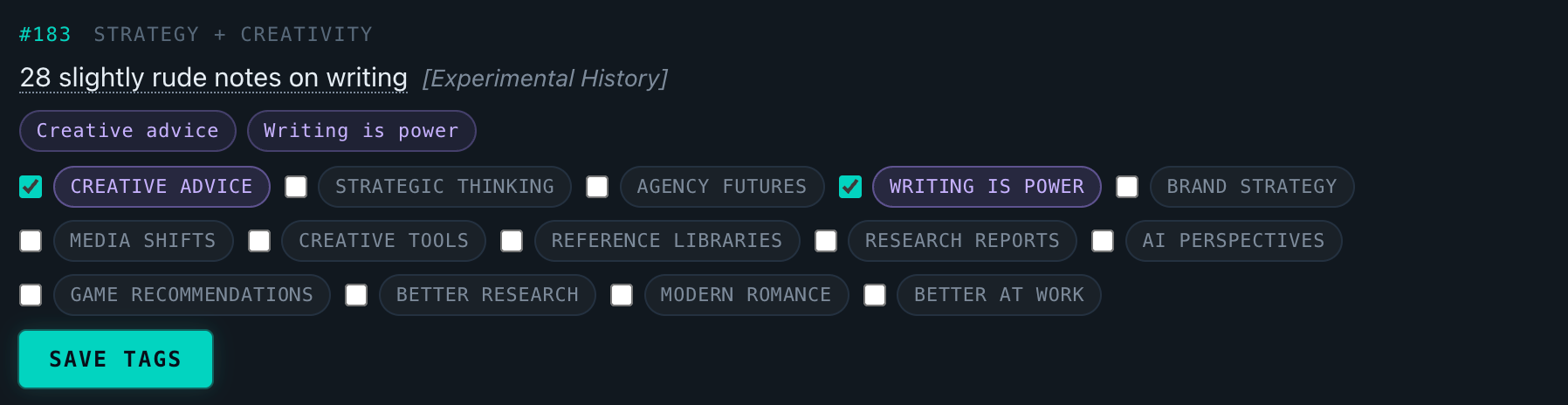
Shelves get organized once per week, when Delightful goes out.
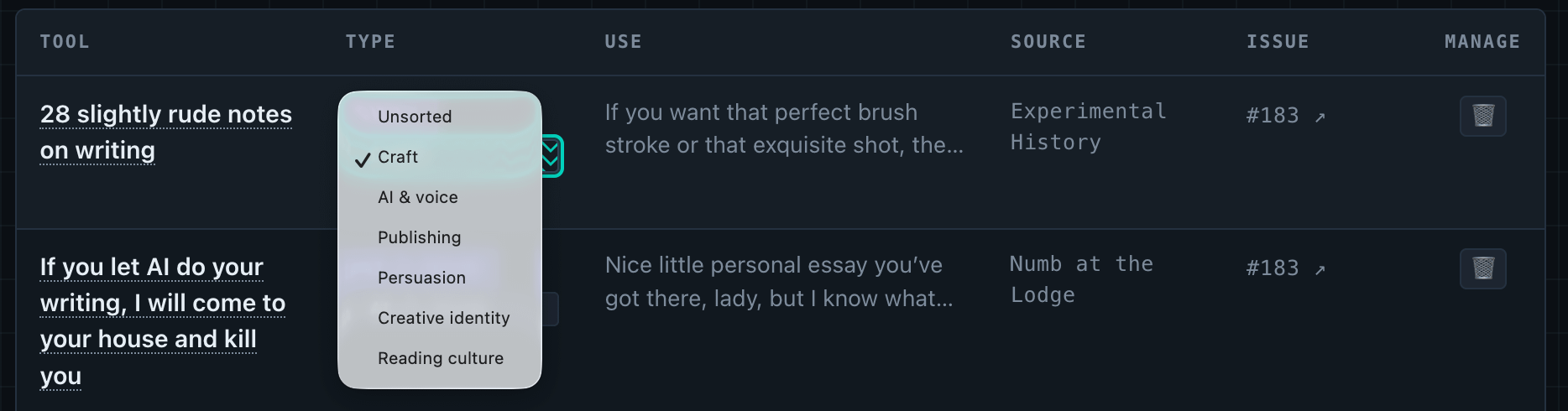
As you might imagine, this gets fairly complex to manage. The use case for the newsletter content is different from the use case for the archive content. Nobody needs an archive of newsletter issues, but everybody benefits from an archive of links from those issues. So a lot of the work is trying to capture and organize data in a way that makes both surfaces useful. We’re not there yet, but as we say in Mexico, poco a poco.
I’ll try and write more about the building process in the future.
Maybe that sounds self-aggrandizing but honestly, it’s so edifying to build your own systems. A lot of us spend time building or modifying or critiquing the systems of others — doing the full work yourself, and feeling that labor in your body, is a better teacher than any theory.
But it so happens i have the theories on hand so oh well here they are lol:
Start simple: every complex system that works evolved from a simple system that worked.
Create first, measure second: when a measure becomes a target, it ceases to be a good measure.
Let the collection teach you: don’t build the museum before you have all the exhibits.
stay gold,
-s.
p.s. all feedback welcomed and encouraged!
Last week’s most-clicked links:
28 slightly rude notes on writing [Experimental History]
If you let AI do your writing, I will come to your house and kill you [Sam Kriss]
Another p.s.: Congrats to John Hazard and crew for making Lighthouse Creative one of the best places to work! Love those guys.


Strategy + creativity
“Everything about the book is mortifying, and it totally set me free.” Why the best writing advice is often the weirdest [The New Yorker]
“Taste is knowledge.” How to have good taste [The Common Reader]
“Real humans use (and made) our product! We swear!” AI companies are using serifs to project humanity. Critics are calling it “tasteslop.” [Wired]
“The labor that AI … leaves behind and intensifies is the labor of seeing. Of noticing what’s working. Of catching what isn’t.” AI makes designers get closer to the work, actually [Christopher Butler]
“You have to do things that are hard to replicate via AI alone. Show up in person. Be personal in your storytelling. Make physical things.” “AI-Powered” Isn’t a Position [First Round Review]
“I remember telling my grandmother about our isolation, and she said, “Have regular parties at your house.” She told me what to do, and we did it, and she was right. God, I owe a lot to my grandmother.” How to cultivate artistic friendships [The New Yorker]
Every VO script right now [LinkedIn]
Work + career
“Familiarity is no longer a flex, it’s the floor.” What strategy directors expect from your AI skills [Rob Salmon] // Good perspective. Years ago, my focus on tech and finance was a competitive advantage because i knew the space. Now everybody can get up to speed on the space quickly. Not that it stops them from doing lazy work after the fact … //
“Yes, the legendary music producer” Rick Rubin Is Hiring an AI Sensei for the Summer [Y Combinator] // I hate everything about this, including the use of the word sensei //
Curiosity + research
“In which I accidentally become the world expert on the placeholder text Lorem Ipsum.” Everything You Know About Lorem Ipsum Is Wrong [Rabbit Hole] // Incredible video from an ex-Verisatium producer. Will make you either v popular or v annoying at your next cocktail party. //
“Surprising, bizarre, never-before-uttered sequences of words or sounds.” The 100 Greatest Bird Names of All Time [Robert Francis] // Reader, I haven’t laughed this hard in a long time. //
Decks + other artifacts
Mesa: This is very cool. It’s like Figma but for working with all documents in the same view. Make sure to check out the live demo. [David Temkin]
Process Pamphlets: A series of physical publications by Ben Denzer intended to show the hidden parts of design that people, especially students, don’t usually get to see [Process Pamphlets]
LLMinality
“Mathematical algorithms on graphics cards cannot become conscious because they lack a complex biological substrate.” No, Artificial Intelligence Is Not Conscious [Ted Chiang in The Atlantic]
“For example, I’ve worked with a brand that used to rank number one for all of their commercial terms on Google — drove a ton of traffic and revenue for years. They’re cited very heavily in AI search now, but often cited as, “by the way, don’t buy from these people.” On AI Search with Tom Critchlow [BRXND Dispatch] // I’ve known Tom for years -- he’s always been super generous and kind. Psyched to see him working with other friends at Alephic. //
Culture + handwringing I guess
“The problem isn’t that men are lonely. The problem is that many men wouldn’t recognize loneliness if it punched them in the gut and poured a beer on their head.” America’s Real Social Crisis Is the Rise of Solitude [Derek Thompson]
“Even the lonely have a tendency to believe that loneliness is their own fault, a product of something essentially dislikable in their own being.” Far-right groups prey on it: Olivia Laing on the weaponisation of loneliness [The Guardian]
“Engineered for convenience, compulsion and stimulation, not for nourishment.” Manage Your ‘Ultraprocessed Time’ [The New York Times]
“God put it on our hearts to specifically preach the gospel through an energy drink.” What would Jesus drink? Welcome to the age of Christian energy beverages [The Guardian]
I don’t like computer anymore [TikTok]
Love or the absence of it
“A “goal-gasm,” if you will.” A Knicks Win Could Do Wonders for Your Sex Life [InsideHook]
“An emotional marketplace.” OnlyFantasy [Spotify] // A deeply reported pod on OnlyFans //
Delightful is a 100% organic, free-range, desktop-to-inbox newsletter with links and things, usually. 1x weekly posts (free), occasional tools and research posts (paid). Your host is Steve Bryant, friendly neighborhood insights and content strategist. Let’s work together or go on a hike or something. steve@thisisdelightful.com
{ 🔒 archive }
Creativity, illustration, language, stuff like that
What did you learn about yourself today?
Notes on picking up drawing 30 years later26 things I’ve learned while learning a language
Notes from someone who’s working at itHow to write
Notes on moving and watching and paying attentionCuriosity and Research 101
Notes on how to find out about thingsA map of what you meant to say
Notes on the 3D space of languageThe A.I. isn’t a moron. She’s your wife.
Notes on making ads with AI
Brand strategy, content strategy, etc
Observational and Culture Study Cheat Sheet
A template and tools for researching people and communitiesMy content strategy toolkit
14 tools for organizing, measuring, and creating contentMy concept diagram template
A Figjam for diagramming the complex relationships between conceptsProduct Content Strategy 101
For anybody who’s creating a product that requires editorial contentThe Bento Box Method for developing topical content
A cute and useful way to structure your content topics
Thanks for reading. Be seeing you.

“You can never be wise until you learn to love reading.”
– Samuel Johnson